May 25, 2026
Nd:YAG vs. Alexandrite Laser: Which is Safest for Middle Eastern & South Asian Skin?
When comparing the Nd YAG vs Alexandrite laser, the beauty industry has a long-standing “dirty secret”: for decades, the technology simply was not designed with dark skin in mind.
If you have Middle Eastern, South Asian, or African heritage, you have likely heard horror stories of laser treatments resulting in painful burns, scarring, or permanent dark patches (hyperpigmentation). But the truth is, laser hair removal is entirely safe and highly effective for deep skin tones—if the clinic uses the correct wavelength.
In Doha, where our population is wonderfully diverse, understanding the difference between the Nd YAG vs Alexandrite laser is the single most important factor in your hair removal journey.
Let’s break down the science of these two powerhouse lasers, how they interact with skin pigment, and exactly what you need to ask your clinician before you ever sit in the treatment chair.
The Golden Rule: It Is All About Melanin and Wavelengths
To understand why one laser is safer for you than another, you need to understand how laser hair removal actually works.
Lasers target melanin (the dark pigment) inside the hair follicle. By heating up this pigment, the laser destroys the follicle and stops future hair growth.
However, melanin is also present on the surface of your skin. The darker your skin, the more epidermal melanin you have. The challenge for medical professionals is to shoot the laser through the skin’s surface without the surface melanin absorbing the heat and causing a burn.
This is where the laser’s wavelength—measured in nanometers (nm)—dictates safety.
The Alexandrite Laser (755 nm): The Champion for Light Skin
The Alexandrite laser operates at a wavelength of 755 nanometers.
How it works: It has an incredibly high absorption rate for melanin.
Who it is for: It is the undisputed gold standard for individuals with pale to olive skin (Fitzpatrick Skin Types I–III) who have dark hair.
The Danger for Darker Skin: Because the Alexandrite laser loves pigment so much, it cannot easily distinguish between the pigment in the hair follicle and the pigment on the surface of brown or dark skin. If used on Middle Eastern or South Asian skin (Fitzpatrick Types IV–VI), the surface skin will absorb the intense heat before it ever reaches the hair root. The result? Severe blistering, burns, and post-inflammatory hyperpigmentation.
The Nd:YAG Laser (1064 nm): The Savior for Dark Skin
The Nd:YAG (Neodymium-doped Yttrium Aluminum Garnet) laser operates at a longer wavelength of 1064 nanometers.
How it works: This longer wavelength has a much lower absorption rate by surface melanin. Instead of getting caught at the epidermis, the laser energy safely bypasses the skin’s surface and penetrates deep into the dermis to strike the hair follicle directly.
Who it is for: It is the safest, most effective, FDA-approved laser for medium-deep to very dark skin tones (Fitzpatrick Skin Types IV–VI), including Middle Eastern, Indian, Pakistani, and African skin.
The Benefit: By bypassing the epidermal melanin, the Nd:YAG eliminates the risk of thermal burns and discoloration, providing a safe path to permanent hair reduction for women and men of color.
The Myth of IPL (Intense Pulsed Light)
Many salons offer inexpensive hair removal using IPL. Do not use IPL if you have brown or dark skin. IPL is not a true laser; it acts like a scattered flashlight of multiple wavelengths. Because it lacks precision, the risk of surface burning on pigmented skin is incredibly high. Always insist on medical-grade true lasers (like Nd:YAG or Alexandrite) in a clinical setting.
The Dangers of "One-Size-Fits-All" Clinics
One of the most common mistakes patients make in Qatar is choosing a clinic based solely on price or convenience, without asking what machine is being used.
When you walk into a clinic, your dermatologist or laser specialist should perform a Fitzpatrick Skin Assessment. If you are a Type IV or V (common for South Asian and Arab descent) and the technician attempts to use an Alexandrite-only machine, you should politely decline the treatment and leave.
Using the wrong laser on pigmented skin can trigger hyperpigmentation that takes months—sometimes years—to correct with chemical peels and targeted skincare.
The Ultimate Solution: Dual-Wavelength Technology
So, which laser is “better”? Neither. They are simply different tools for different canvases.
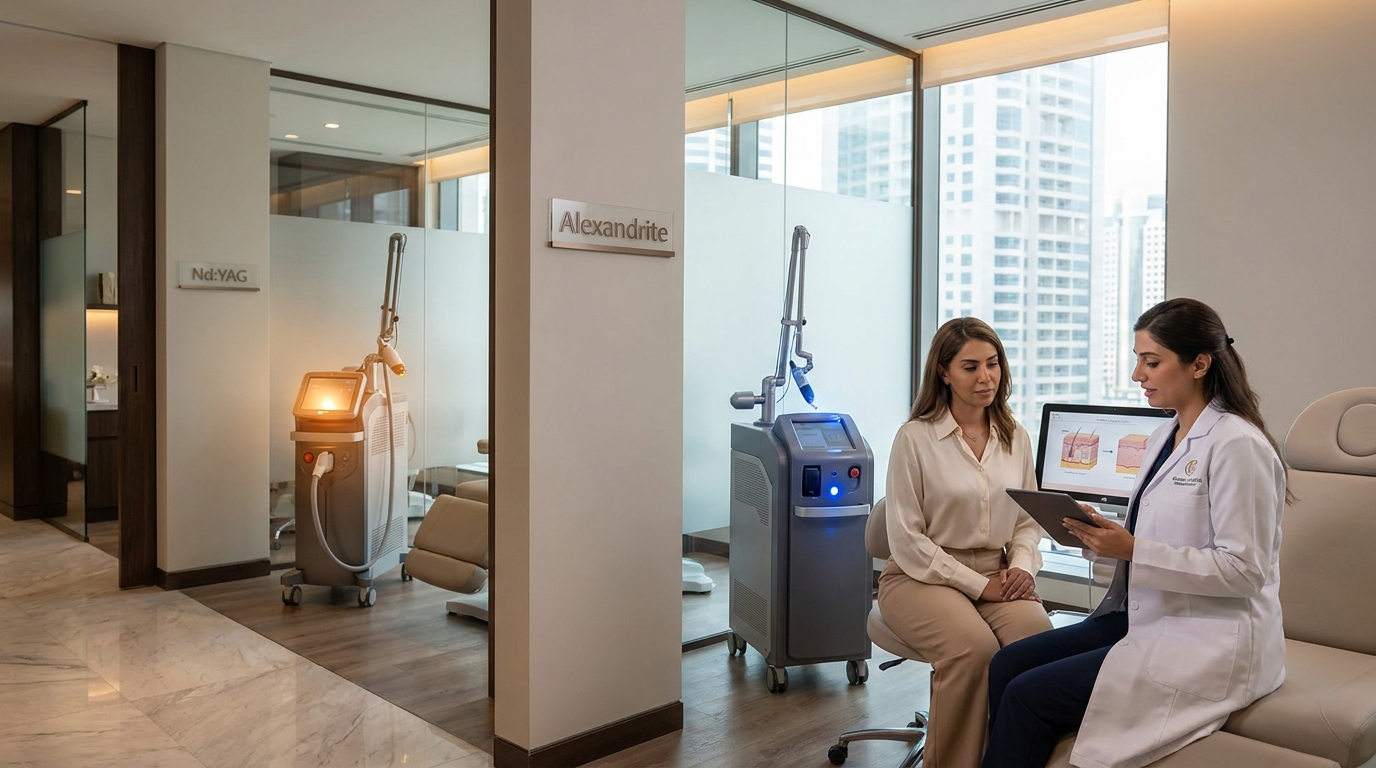
The best aesthetic clinics no longer force patients to choose. At The Wellness Lab in Doha, we utilize state-of-the-art dual-wavelength platforms, including the Candela Gentle Pro and Cynosure systems.
These premium medical machines house both the Alexandrite and the Nd:YAG lasers in a single device. This gives our medical experts the power to customize your treatment with absolute precision.
If you have fair skin on your legs but slightly darker, more pigmented skin in sensitive areas (like the bikini line or underarms), we can seamlessly switch wavelengths during your session to ensure maximum safety and efficacy.
Navigating Laser Hair Removal in the Doha Climate
Living in Qatar means dealing with intense year-round sun. UV exposure activates melanin, meaning a fresh tan temporarily changes your skin type.
The Rule: You must stay out of direct sun for at least two weeks prior to your session. If you return from a beach holiday in Katara or West Bay with a fresh tan, a responsible clinician will reschedule your appointment or switch to the Nd:YAG setting to protect your skin.
Ready for Safe, Flawless Skin?
You do not have to compromise on safety to achieve smooth, hair-free skin. Whether your skin is fair, olive, deep brown, or rich melanin, the medical experts at The Wellness Lab in Al Hilal, Doha, have the technology and the training to treat you safely.
Do not risk your skin with outdated technology or under-trained technicians.
Book Your Personalized Laser Consultation at The Wellness Lab Today – Let our certified specialists assess your skin type and design a permanent hair reduction plan tailored just for you.
FAQs
Q: Does the Nd:YAG laser hurt more than the Alexandrite?
A: Historically, Nd:YAG was slightly more uncomfortable due to its deeper penetration. However, modern machines like the Candela Gentle Pro used at The Wellness Lab feature advanced integrated cooling systems (Cryogen gas). This numbs the skin milliseconds before the laser pulses, making treatments incredibly comfortable for all skin types.
Q: Is laser hair removal safe for Indian and Pakistani skin tones?
A: Yes, absolutely. South Asian skin typically falls into Fitzpatrick Types IV or V. The Nd:YAG (1064nm) laser is the gold standard for these skin types because it safely bypasses surface melanin to target the hair root without causing burns.
Q: Can Alexandrite laser cause hyperpigmentation?
A: On light skin, no. But on olive, brown, or dark skin, the Alexandrite laser can cause post-inflammatory hyperpigmentation (dark spots) or hypopigmentation (white spots) because the laser energy is absorbed by the skin’s surface pigment rather than the hair follicle.
Q: How many Nd:YAG sessions are needed for permanent hair reduction?
A: Most patients achieve 80% to 90% permanent hair reduction within 6 to 8 sessions, spaced about 4 to 6 weeks apart. Hormonal areas, such as the face, may require a few extra maintenance sessions.
Q: Can I get laser hair removal in Qatar during the summer?
A: Yes, you can. However, you must be diligent about sun protection. You must avoid direct sun exposure and tanning beds for two weeks before and after your treatment, and wear broad-spectrum SPF 50 daily.